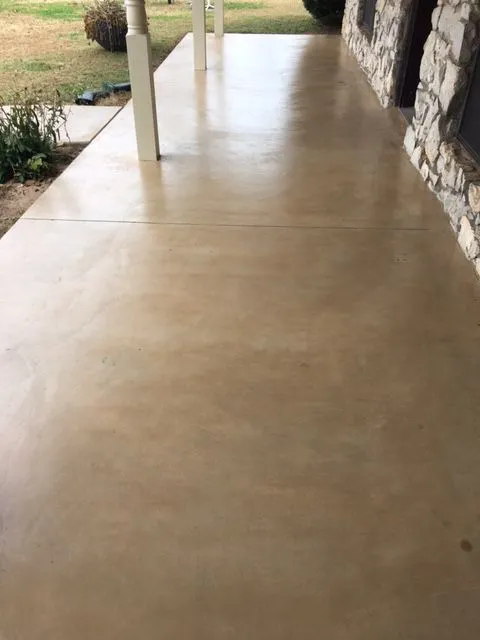
Two questions settle most permit matters here: is the work on your own lot or in the street right of way, and is it flatwork or a structure? We check the rules for your address before work starts. The points below come from the Santa Rosa City Code and the county's published lists, checked in October 2026.
Do I need a permit for a driveway or patio?
For a ground-level patio or the part of a driveway on your own lot, you generally do not need a building permit. Any part in the public right of way is different. Santa Rosa City Code section 13-04.030 makes it unlawful to do work there without an encroachment permit, and that covers the driveway approach, the curb and the public sidewalk. In the unincorporated county, Permit Sonoma lists walks, non-structural slabs and paving on private property outside the county right of way as exempt from a building permit. Slabs that carry a building, raised patios and anything on an accessible route are treated as structures. Confirm with the Planning and Economic Development counter for your address.
Do I need a permit to widen my driveway?
If you widen only the part on your lot, usually not, though zoning rules on front yard paving and parking may limit how far you go. If you also widen the opening at the curb, yes. That is work in the right of way and needs a Santa Rosa encroachment permit. City Code section 13-04.260 requires right of way work to be done by a contractor with a valid California licence.
Who owns the driveway apron: me or the city?
The apron, also called the approach, sits in the public right of way, so the city controls how it is built. You, as the fronting owner, normally pay for building and repairing it. Standard city details set its thickness, slope and width, and an encroachment permit and inspection apply.
Who is responsible for the sidewalk in front of my house?
You are. Santa Rosa City Code section 13-32.020 says owners of lots fronting a sidewalk area shall repair and maintain it. The same section says the owner owes a duty to the public and can be liable when someone is hurt because the sidewalk was not kept up. The city's sidewalk program page states the same rule and notes that crews may place a temporary asphalt patch over a raised edge until the owner makes the permanent repair. California Streets and Highways Code section 5610 sets the same owner duty statewide.
The city sent me a notice to fix the sidewalk. What do I do?
Read the deadline on the notice and act inside it. The Santa Rosa code follows the state procedure for sidewalk repair notices. If the owner does nothing, the city may have the work done and charge the owner, including its own costs, and the charge can become a lien. The code lets the director extend the period, so ask in writing if you need more time. Get a quote, take out the encroachment permit and keep the paperwork.
Must I use the city's contractor, or can I hire my own?
You may choose your own contractor. That contractor must hold a current California licence, as the city code requires for right of way work, must take out the encroachment permit and must carry the liability insurance the city asks for. The code sets that insurance at no less than $1,000,000 per occurrence and $2,000,000 aggregate, with the city named as additional insured.
How close to the property line can I pour concrete, and do I need a survey?
Flat concrete at ground level can usually run up to the property line, because setbacks apply mainly to buildings. Three cautions apply. Do not send your runoff onto the neighbor. Leave room to form and finish the edge without stepping next door. And check for easements, since a utility can dig up a slab that sits over its line.
A survey is not needed for most jobs. It is worth having when the slab or wall will sit close to a boundary that is not clearly marked, or when a neighbor disputes the line. Fences are often off the true line by a foot or more, so do not rely on one. Santa Rosa's retaining wall policy ties the permit exemption to the distance from the property line, so for a wall near the boundary the line needs to be known.
Do I need HOA approval?
If you live in an HOA, very likely. Planned neighborhoods across Santa Rosa, including many in Fountaingrove, Skyhawk and Oakmont, have design rules covering driveways, visible patios, color and stamped finishes. HOA approval is separate from any city permit and can take several weeks. Get it in writing before signing a contract.
How much of my lot can I cover with concrete?
That depends on your zoning district. Santa Rosa's zoning code sets lot coverage and front yard landscaping standards, and larger projects that add a lot of impervious surface fall under the city's storm water rules. We could not confirm one figure that applies to every residential lot, so we do not quote one. Ask Planning for the standard at your address, or let us check as part of the estimate.
When does a retaining wall need an engineer or a permit?
In Santa Rosa, a retaining wall needs a building permit when it is more than 4 feet tall measured from the bottom of the footing to the top of the wall, when it is taller than its distance from the property line, or when it supports a surcharge such as a slope, driveway or building. The city's retaining wall policy says every wall that needs a permit must have an engineered design. In the unincorporated county the threshold reads differently: Permit Sonoma exempts walls that retain no more than 3 feet of material and carry no surcharge.
How do I find underground utility lines before digging?
Contact 811. In this part of California the one-call centre is Underground Service Alert of Northern California and Nevada, known as USA North 811. State law requires notice at least 2 working days before digging, not counting the day you call, and no more than 14 calendar days ahead. The service is free. Member utilities mark their own utility lines. Private lines such as sprinkler pipe, yard lighting and a line to a detached garage are not marked, so tell us about them. When we do the digging, we make the request.
I need a wheelchair ramp and a wider walkway. Are there rules?
For a private home, a ramp is not held to public access standards, but those standards are a sound guide: a slope no steeper than 1 inch of rise per 12 inches of run, a clear width of at least 36 inches, level landings and edge protection. A ramp raised well above grade or attached to the house can need a building permit. For a business, accessible routes are regulated under the California Building Code and must be built to its dimensions.
My house is in a historic district, or has old decorative concrete. Does that change things?
It can. Santa Rosa has preservation districts near downtown, among them McDonald, St. Rose, West End and Burbank Gardens. Visible exterior changes in a historic district may need review by the Planning division, and that can include replacing an old scored walk or a ribbon driveway with something different. Where old decorative concrete is sound, repairing it or matching its pattern is usually the easier path. We could not confirm the exact review triggers for flatwork, so ask Planning before changing the look.
Are there tree rules that affect concrete work?
Yes. Santa Rosa regulates the removal of heritage trees through its Planning department, and street trees belong to the public right of way. Section 13-32.010 of the city code also asks owners to keep trees trimmed to at least 8 feet clear above the sidewalk. Before cutting large roots or taking out a tree to save a slab, check with the city.
Rules change, and this page is general information. For your address, call (707) 385-5837 and we will check what applies.