New concrete changes a lot in its first weeks, and some of what worries owners is ordinary. Other things are real defects that the installer should correct. Here is how to tell them apart.
Why is my new concrete already cracking?
New concrete can crack within days because it shrinks as it dries. Fine hairline cracks are common and usually harmless. Wider cracks that wander across a panel instead of following the joints suggest the joints were cut too late, too shallow or too far apart, or that the surface dried too fast. Dry north winds in late summer and fall pull water out of a fresh slab quickly.
Is the contractor responsible for a crack that appears weeks later?
The contractor is responsible when the crack comes from workmanship: missing joints, a thin slab, a poor base, or no curing. A hairline shrinkage crack is generally treated as normal for the material. What your written contract says matters most. In California the Contractors State License Board accepts complaints about poor workmanship by licensed contractors. Take dated photos with a coin or tape for scale, and tell the contractor in writing.
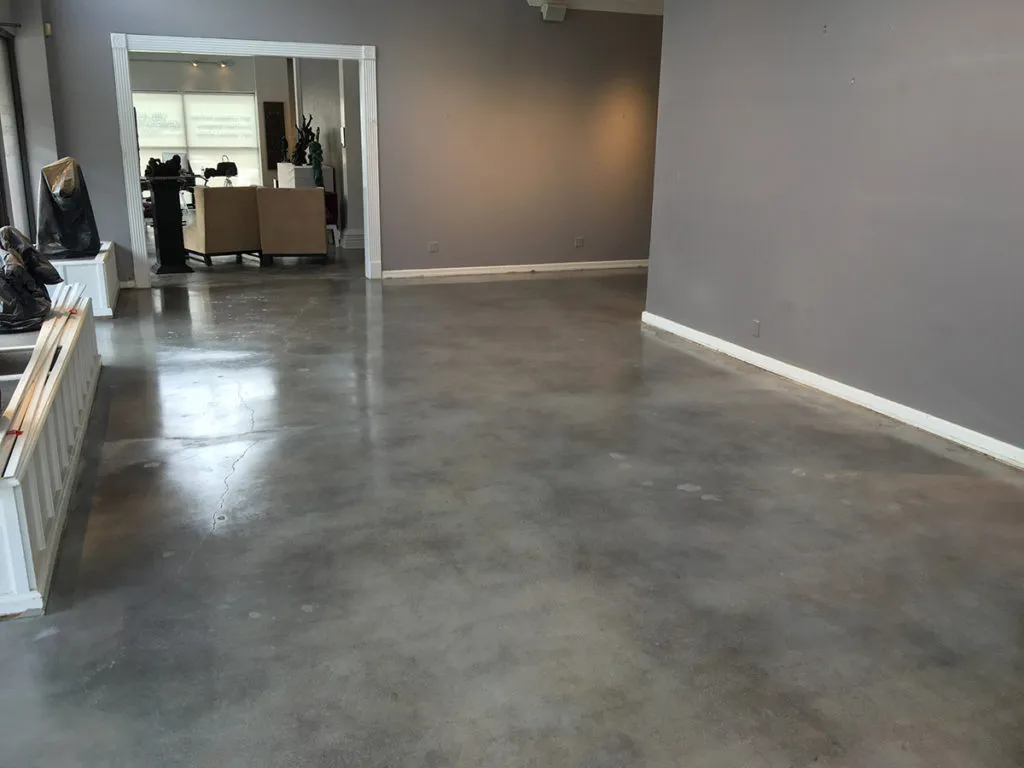
Why does my new concrete have dark and light patches?
Dark and light patches in the first weeks are mostly uneven drying. Shaded spots, thicker areas and places that stayed damp cure darker. Much of this fades over a few months. Lasting blotches come from concrete delivered in different loads, water or cement sprinkled on during finishing, or a curing blanket that touched the surface unevenly. Give a new slab a full dry season before judging its color.
What happens if it rains on fresh concrete?
If it rains on fresh concrete in the first few hours, the surface can be pitted, washed or weakened. Light rain after the slab has stiffened usually leaves no harm, and after about a day rain actually helps curing. A weakened top shows up later as dusting or flaking. Winter pours here are scheduled around the forecast and plastic sheeting is kept on hand.
There are footprints, rough spots and a wavy finish with low spots. Is that acceptable?
No. Footprints, trowel marks, rough patches and birdbaths that hold water are finishing faults, not normal variation. A common test for a low spot is whether a puddle is still there a day after rain. Small flaws can sometimes be ground or patched, though the repair will show. Widespread problems may call for an overlay or a new pour. Raise it before you make the last payment.
Are control joints really necessary, and is it fine to saw-cut them a week later?
Yes. Control joints are planned weak lines that tell the slab where to crack. Without them it cracks wherever it likes. On a 4-inch slab they are usually spaced about 8 to 12 feet apart and cut to about a quarter of the slab depth. On swelling clay, closer spacing is safer.
A week is far too late. Saw-cut joints should go in as soon as the concrete can take the saw without tearing, usually within 6 to 18 hours and sooner in hot weather. By day seven the slab has often already cracked on its own. Ask for the joints to be cut the same day or early the next morning, or tooled in while the concrete is wet.
My slab was poured without rebar or mesh and I only found out afterwards. Is it ruined?
Not necessarily. A slab poured without rebar or mesh can serve well as a patio or walk if the base is firm and the joints are right. Steel does not stop cracks. It holds cracked pieces tight and level. For a driveway on clay, or any slab your contract said would be reinforced, its absence is a real shortfall. Check the contract. If steel was listed and left out, you did not get what you paid for and should say so in writing.
What can I do if the contractor will not come back to fix it?
Put the problem in writing with photos and a date by which you expect an answer. If the contractor still will not come back, file a complaint with the California Contractors State License Board, which can investigate licensed contractors and offers dispute programs. Small claims court is another route for modest sums. Keep the contract, proof of payment and every message.
My new stamped concrete is slippery, or it has turned cloudy, faded or started peeling. Can that be fixed?
Yes. Stamped concrete turns slippery when a glossy film-forming sealer sits on a smooth pattern, and winter rain or pool water makes it worse. The fix is a grit additive in the next sealer coat, or stripping the glossy sealer and using a lower-sheen product. Ask for the additive from the start on slopes, steps and pool surrounds.
A cloudy or white haze is moisture caught under the sealer. It happens when sealer goes on too thick, over damp concrete, or just before a foggy night. Peeling is usually too many coats built up. Fading is sun on the color and on worn sealer. Haze can often be cleared with a solvent treatment. Peeling sealer has to be stripped and reapplied thinly.
The surface started flaking within the first year. Why?
Flaking in the first year points to a weak surface from the day of the pour. Typical causes are finishing over bleed water, adding water to the top, rain on the fresh slab, or poor curing. In cold regions the first winter of ice and salt does this, but Santa Rosa winters are too mild for that to be the usual reason. Report it to the installer promptly and in writing.
It was poured in a heat wave and now looks bad. Was that a mistake?
Concrete poured in extreme heat needs extra steps, and trouble follows when they are skipped. Above about 90 degrees with wind, the surface dries before the crew can finish it, which leaves fine cracks, a crusty top and uneven color. Starting at dawn, dampening the base, using a retarder and curing right away prevent most of it. If none of that was done on a hot day, the damage is a workmanship matter.
The stamped pattern is crooked and uneven, and I still owe the final payment. What now?
Hold the final payment for the disputed part until you and the contractor agree a remedy in writing, and pay what is clearly owed for good work. Stamping cannot be redone once the concrete is hard. Realistic remedies are a price reduction, re-coloring to soften the look, or replacing the worst panels. The Contractors State License Board advises owners not to let payments get ahead of the work, so a held balance is your proper leverage.
The crew left ruts in the lawn, washout, splatter and the forms still on. Who deals with that?
The contractor does, unless the contract says otherwise. Ruts from trucks and buggies, concrete washout dumped on soil, and splatter on siding, fences or the neighbor's car are part of leaving the site clean. Washout water is highly alkaline and must not reach a storm drain. Splatter is easiest to remove in the first day or two, so point it out quickly.
My new pad is out of level. Is that a defect?
It depends on what the pad is for. Outdoor slabs are meant to slope, commonly about one eighth to one quarter inch per foot, so rain runs off. A pad that is out of level in the wrong direction, that holds water, or that was specified dead level for a spa or equipment and is not, is a defect. Check it with a long level and compare against the contract or drawing.
Wood forms are normally pulled a day or two after the pour. Forms left on for weeks swell, bond to the edge and can chip it on the way out. They also hide honeycombing along the sides. Ask the contractor to return, strip them carefully and backfill against the slab edge so the base is supported.
Not sure whether what you see is normal? Call (707) 385-5837 or text a photo, and we will tell you what we think.